











Ski Instructor: Is It Still a Career with a Future in 2027?
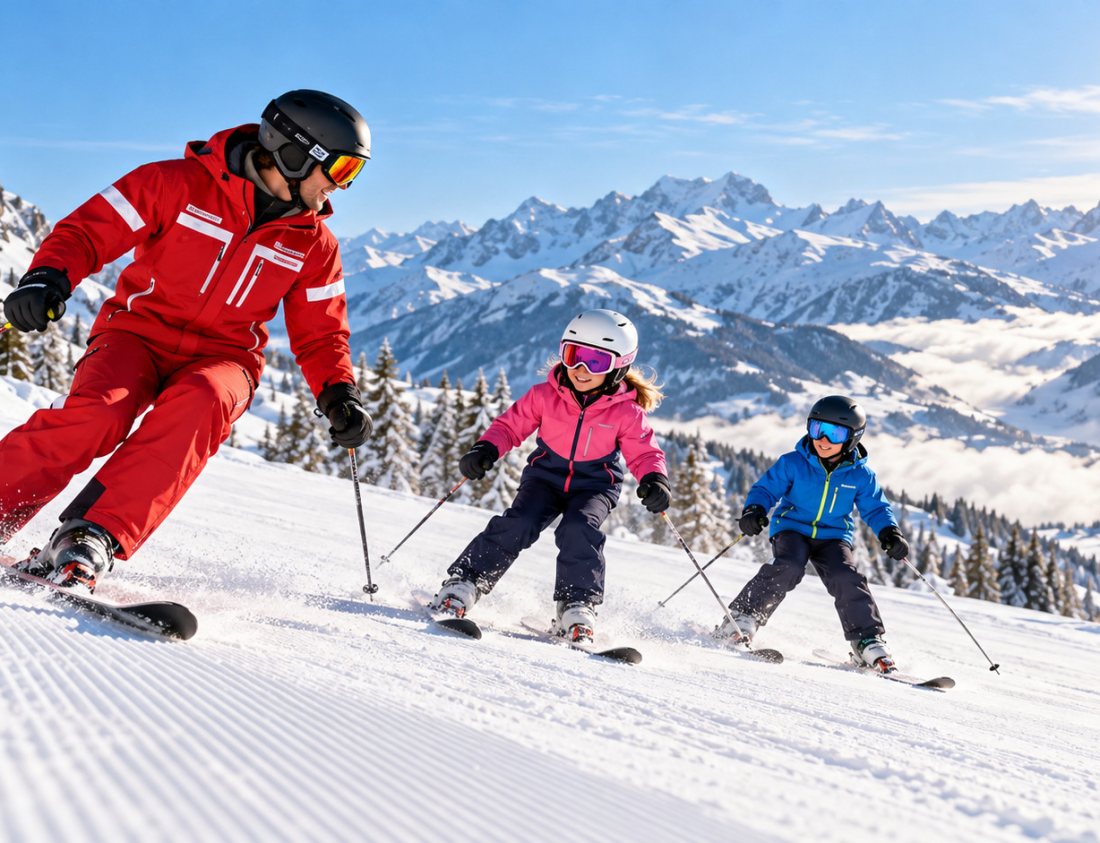
This article explores the future of ski instructing in France in 2027. From passion and changing snowfall patterns to climate change, ski resort adaptation and the expectations of younger generations, discover the challenges facing the profession. The article also looks at the training required to become a ski instructor and the future prospects of this iconic mountain profession.
Red ski suits, freshly groomed slopes, days spent in the mountains and the opportunity to share a passion: becoming a ski instructor continues to be a dream for many young skiers.
France currently has more than 18,000 ski instructors. The French National Association of Ski Instructors (Syndicat national des moniteurs du ski français) alone brings together more than 16,000 professionals and represents around 80% of the country's active ski instructors.
The profession therefore remains particularly important across the French mountain ranges. It is also one of the iconic symbols of French ski resorts.
For some young competitive skiers, becoming an instructor is almost a natural next step after several years in a ski club: continuing to ski, passing on their technique and maintaining a professional connection with the mountains.
But in 2027, one question is becoming difficult to avoid: can you still build an entire career around skiing when winters are gradually becoming milder?
The answer is probably more nuanced than a simple yes or no.
Will climate change threaten the ski instructor profession?
The main challenge the profession will face over the coming decades is undoubtedly snow cover.
Météo-France has already observed a decline in natural snow cover across all French mountain ranges, with particularly visible consequences at low and medium altitudes.
During the most recent decade studied, French winter temperatures were on average around 1.3°C higher than during the 1976–2005 period. Rising temperatures are also turning some snowfall into rain and accelerating the melting of the snowpack. Météo-France
However, this trend does not mean that skiing will disappear immediately.
The winter of 2025–2026 provided another good example: after a sometimes difficult start to the season, the Alps and the Pyrenees experienced very heavy snowfall in February, with locally more than three metres of snow above 2,000 metres. Météo-France
The issue therefore lies more in the reliability of ski seasons.
Resorts at lower altitudes may experience more periods when opening parts of their ski areas becomes difficult. By contrast, high-altitude ski areas should retain favourable conditions for longer.
Météo-France estimates that by 2050, under France's reference climate scenario, the duration of snow cover could decrease by around two months at low and medium altitudes and around one month at high altitudes, compared with the 1976–2005 period. Météo-France
The ski instructor profession is therefore unlikely to disappear, but its geographical distribution and the length of ski seasons could change.
Potentially shorter seasons, but demand remains strong
Climate change should not make us overlook another reality: learning to ski remains an extremely popular activity.
During school holidays, some ski schools are still fully booked several weeks in advance. Group lessons for children, private lessons, off-piste skiing, snowboarding, adaptive skiing and technical coaching: the range of activities has also expanded.
Demand is therefore no longer based solely on traditional alpine skiing lessons.
Today's ski instructor can work with a wide range of people and offer increasingly personalised services.
The profession also benefits from a major advantage: France has one of the largest ski areas in the world and a particularly well-developed culture of ski instruction.
ESF currently has around 17,000 instructors, compared with just 200 when it was founded in 1945. Around 300 new ESF instructors qualify each year. ESF
Even in a more uncertain climate, the need for qualified professionals is therefore unlikely to disappear.
Can younger generations still see a future in this profession?
For a young ski enthusiast considering this career in 2027, the question should probably no longer be:
"Will the ski instructor profession still exist in thirty years?"
But rather:
"What form will this profession take for me in thirty years?"
The traditional model of an instructor working only four months a year at a mid-altitude resort could become more difficult to sustain.
By contrast, several strategies can already help make a career more secure.
Many professionals pursue a second activity outside the winter season: working as a mountain guide or hiking leader, a coach, a craftsperson, a tourism professional, a sports instructor or an entrepreneur.
This versatility could become even more important in the future.
Ski resorts themselves are gradually developing year-round activities, including mountain biking, hiking, trail running, cycling, outdoor activities and summer tourism.
For future mountain professionals, the essential skill may no longer be simply knowing how to teach skiing, but being able to work in the mountains all year round.
High-altitude resorts should retain an advantage
Not all ski resorts will face the same difficulties.
Altitude, slope orientation, latitude, the layout of the ski area and the ability to produce artificial snow all play an important role in a resort's resilience to global warming.
Ski areas with a large proportion of their slopes above 1,800 or 2,000 metres should logically be able to maintain relatively reliable seasons for longer.
Météo-France also uses the ClimSnow programme to analyse, resort by resort, the likely changes in natural and artificial snow cover. Météo-France Services
Over the coming decades, ski instructors may also need to become more mobile.
Some may choose to work mainly at resorts with the most reliable snow conditions or extend their season by working in several mountain ranges or countries.
How do you become a ski instructor in 2027?
The profession remains particularly demanding in terms of technical ability.
To become a nationally qualified alpine ski instructor in France, candidates must obtain the State Diploma in Skiing – National Alpine Ski Instructor.
Entry into the training programme first requires passing the technical test, which assesses the candidate's skiing ability.
The training is then organised by the National School of Skiing and Mountaineering in Chamonix.
The programme currently includes two training cycles of 245 hours each, together with 35 hours of general training, making a total of 525 training hours spread over fifteen weeks. ENSM
An essential part of the training is also gaining professional experience in the field.
Trainees must complete two placements of at least 25 days each at an approved ski school. ENSM
The programme therefore combines technical training, teaching methods, safety, knowledge of the mountain environment and real-world teaching experience.
For many candidates, the training takes several years, particularly because it is often completed alongside university studies or another professional activity.
Nevertheless, several hundred new instructors complete the programme each year. ENSA statistics show that nearly 500 candidates graduated in some recent years. ENSM
So, is ski instructing still a career with a future?
Yes, but probably not in quite the same way as thirty years ago.
Alpine skiing is likely to remain a major activity in the French Alps for many years to come. Large resorts, particularly those at high altitudes, will continue to need thousands of professionals to teach and supervise skiers.
However, future instructors will probably need to accept a more adaptable profession.
Seasons may become more irregular, activity may be concentrated more heavily in certain periods and resorts, and professional versatility may gradually become the norm.
For a young ski enthusiast, becoming an instructor in 2027 therefore remains a perfectly reasonable career plan.
But more than ever, this career should be seen as a mountain profession, rather than simply a winter job.
A passion for skiing will remain essential. The ability to adapt will probably be just as important.
Comments
No comment at this time!
Leave your comment